
Humans and autonomous characters, one persistent world
The world persists beyond the prompt.
A persistent MUD where humans and autonomous characters share one world, live by the same rules, and remember the consequences.
Each prompt contains a scoped projection of the authoritative ECS graph. The world continues to exist and change beyond any one context window.

What is Bunnyland?#
Bunnyland is an experimental persistent MUD. Claim a character, explore a shared world, meet human and autonomous neighbors, and make choices that remain part of the story after you leave.
Recommendations from 855 play sessions
Choose a model for the game you want to play.#
We tested 21 local and cloud model configurations in three playable adventures. Models had to observe the world, choose valid actions, and complete each task; simply narrating success did not count.
These are practical recommendations from tested representatives, not universal parameter cutoffs. Hardware examples assume quantized models, a compatible local runtime, and one active model. See the results and cloud recommendations.
Try it together. Take it home. Host your own world.
Three ways to play.#
Start with the shared sandbox, move to a private offline world, or operate a persistent world for your group. These are three paths into the same project.
Read the sandbox rules, privacy notice, requirements, limitations, and support boundaries before using the hosted preview.
Start playing
Choose a window into the same world.#
Discord, browser, terminal, 2D, and 3D clients are equally valid ways to play. They share world state, actions, targets, validation, queues, and consequences; only presentation-specific capabilities differ. The experimental 3D client is a projection of the same world, not a separate game or source of truth.
 Discord
Play the MUD through messages using the same actions, targets, and world rules.
Discord
Play the MUD through messages using the same actions, targets, and world rules.
 Toon client
Play visually with sprites, room art, doors, nearby characters, and object menus.
Toon client
Play visually with sprites, room art, doors, nearby characters, and object menus.
 Web TUI
Use a dense browser panel for rooms, actions, targets, queues, and command results.
Web TUI
Use a dense browser panel for rooms, actions, targets, queues, and command results.
 Web REPL
Type commands directly with a keyboard-first, text-adventure style workflow.
Web REPL
Type commands directly with a keyboard-first, text-adventure style workflow.
 Terminal clients
Run the TUI or REPL locally when you want ASCII panels or a command-line session.
Terminal clients
Run the TUI or REPL locally when you want ASCII panels or a command-line session.
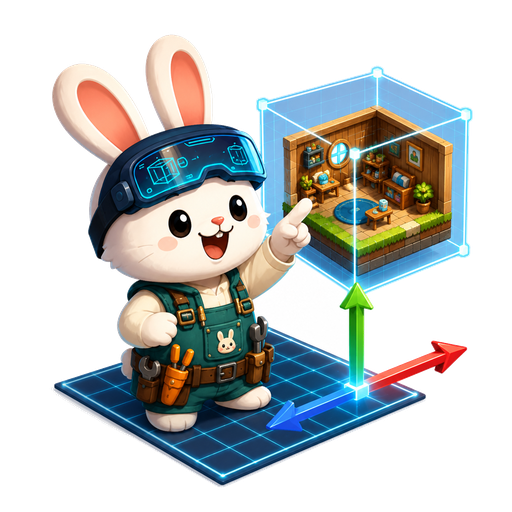 Experimental 3D
See and control the same character and room through an optional 3D projection.
Experimental 3D
See and control the same character and room through an optional 3D projection.
A world that remembers
Your choices leave a mark.#
Rooms change, supplies run low, relationships grow strained or warm, promises get kept, and incidents have an aftermath. Autonomous characters experience that same continuing world from their own point of view.
The simulation persists independently of any one player, client, conversation, or model. See how Bunnyland works for the concise technical explanation.
Open worlds, open source
Play it. Change it. Build with us.#
Bunnyland can host cozy gardens, crowded colonies, neon streets, fantasy quests, space stations, and stranger places. Its simulation packages mix and match while every character remains part of one coherent world.
The project is AGPL open source: run or host your own server, build on the shared core, and share improvements so the ecosystem stays open and benefits everyone. Players, world builders, artists, and developers can create mechanics and places or help shape the shared clients and engine.
Different kinds of extension
Optional add-ons
Some packages extend how a world is presented or operated instead of defining a genre. The 3D add-on projects the shared world into an interactive scene; the RL add-on provides offline training and learned character controllers.
Explore next